

The visibility gap in today’s supply chains
Every day, modern supply chains move at a massive scale: millions of totes, pallets, containers, and parcels flow between factories, warehouses, and distribution centers. For logistics providers, keeping track of these assets has never been more complex, and their customers’ expectations have never been higher.
Manufacturers, retailers and consumers are no longer satisfied with simply knowing where their assets are. They now demand end-to-end visibility: from the production line all the way to final destination. And beyond location, they’re looking to understand the real-time conditions of transport:
- Was this batch of pharmaceuticals kept at the right temperature?
- Was my package damaged or opened in transit?
- How long did this pallet remain stuck in a staging area, and why?
These questions are critical. They directly impact customer satisfaction, product quality, regulatory compliance, and loss reduction. In other words, visibility has become a critical requirement, not a “nice to have.” As a result, shipping carriers worldwide are under pressure to provide more frequent, transparent, and responsive tracking data, delivering real-time visibility while keeping costs under control. On top of that, the sheer number of assets moving every day amplifies the need for scalable and easy-to-deploy tracking solutions.
Shippers who can deliver on this will not only meet customer expectations but also position themselves as indispensable business partners in the world of logistics.
So, where is the challenge?
Traditional tracking systems were never designed to deliver continuous and contextual visibility. Some are too limited in the data they provide, while others are too costly and complex to deploy at scale.
That leads to the real question: How can assets be tracked intelligently, continuously, and cost-effectively at scale, and without adding operational complexity?
I. Why traditional technologies can’t fully meet end-customer expectations
Customers today expect much more than location data: they want continuous visibility, contextual information about conditions, seamless integration into their systems, and solutions that scale without maintenance. They also expect these solutions to remain cost-effective, even when deployed across millions of assets.
For decades, three main families of asset tracking technologies have dominated the logistics landscape. Each has its strengths and value, but neither can fully deliver the continuous and contextual visibility that modern supply chains require at scale.
Tracking technologies: simple, scalable, and cost-effective, but limited
Barcodes and QR Codes: simple but manual
Barcodes and QR codes remain the simplest and most universal solution. They are easy to print, easy to deploy, and can scale effortlessly to millions of items. But their simplicity comes at a cost. Each scan requires manual handling and line-of-sight, which slows down operations and causes errors. More importantly, they only capture isolated moments in time. There is no automation, no context, and no continuous visibility, only fragments of information in a supply chain that increasingly demands a complete and uninterrupted view.
RFID (Radio Frequency Identification): automated but binary
RFID was introduced to overcome these limits and has since become a cornerstone of logistics tracking. Tags are robust, inexpensive, and maintenance-free, and the technology enables automated, hands-free detection. As a tag passes through the field of a reader, the system can easily register entries or exits at scale. However, this automation comes with significant constraints. Effective deployment requires costly infrastructure, including antennas, gateways, and readers. Even more limiting, RFID delivers only binary visibility: a tag is either detected or not, with nothing in between. This “snapshot” approach leaves customers blind to the actual conditions of transport, dwell times, or potential mishandling. For critical flows such as cold chains or high-value goods, these blind spots are unacceptable.
Battery-powered IoT sensors: data-rich, but difficult to scale
At the other end of the spectrum, battery-powered IoT sensors deliver much more granular visibility. They can measure temperature, humidity, orientation, shocks, and tampering, and transmit this data in real time via BLE, LoRaWAN®, or cellular networks.
One clear advantage is that, unlike barcodes or QR codes, these sensors do not rely on manual scanning: they automatically capture and transmit data, enabling continuous monitoring without human intervention. Another key benefit is that, unlike RFID, they do not require costly infrastructure such as networks of antennas and readers. They can be deployed flexibly and start transmitting data almost immediately.
From a customer perspective, this seems like the ideal solution: full visibility, real-time context, and seamless automation. Yet reality is more complex. The Achilles’ heel of these devices is their dependence on batteries, which typically last only two to several years. Large-scale deployments therefore face rising maintenance costs, frequent service interruptions, and inevitable data gaps when batteries fail or have to be replaced.
And as the number of devices grows, so does the burden: thousands of sensors must be maintained, tracked, and recharged or replaced. Beyond the operational overhead, there is also the environmental cost of managing end-of-life batteries, two factors that make scaling increasingly complex.
In practice, battery-powered sensors work well for specific, high-value shipments, but become unsustainable when applied to continuous flows across millions of assets.
The bottom line
The bottom line is clear: barcodes and QR codes are simple and cheap, but entirely manual and blind to real-time conditions. RFID introduces automation, yet at the cost of heavy infrastructure and with visibility that remains fundamentally binary. Battery-powered IoT sensors finally offer real-time contextual data without infrastructure, but their short lifespan and high maintenance needs make them unsustainable at scale.
Therefore, the next step in reaching a real breakthrough comes from eliminating the weakest link: the battery itself.
II. How Organic Photovoltaics Cells Enable Continuous, Battery-Free Logistics Visibility
By eliminating its battery, a sensor must therefore be able to generate its own energy directly from its environment.
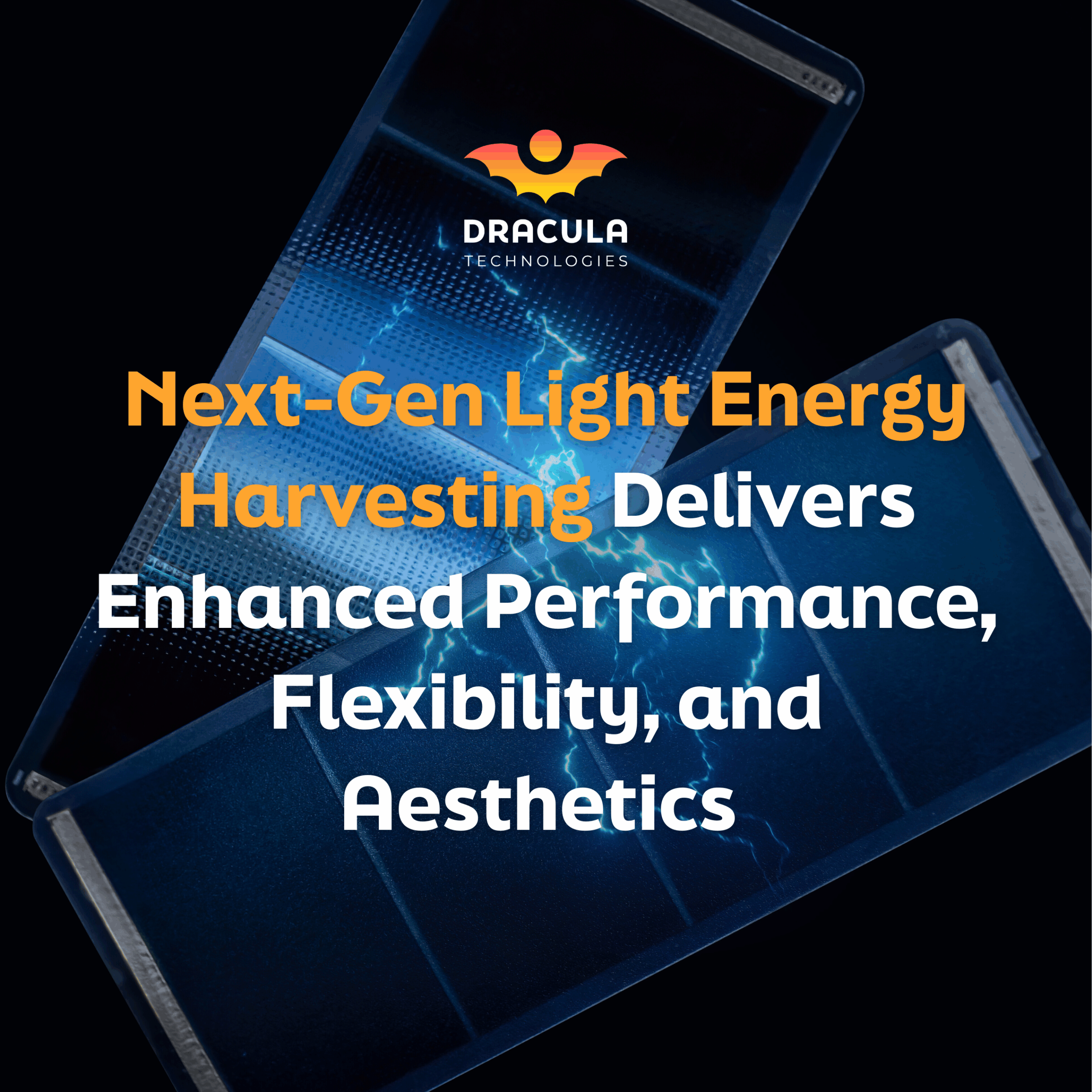
This is exactly what Dracula Technologies enables with Organic Photovoltaics (OPV). Designed to operate under the weak and variable lighting conditions typical of warehouses and vehicles, these ultra-thin, flexible modules harvest energy even at 5 lux, the level of a dim corridor. Unlike conventional solar panels, organic photovoltaic cells are lightweight, non-toxic, and recyclable. It integrates seamlessly into thin smart labels without altering packaging or existing workflows.

Powered by light energy harvesting, sensors achieve:
- Scan-free operation: Continuous visibility without human intervention
- Continuous operation indoors and outdoors, even under low light;
- Real-time transmission of critical data (temperature, orientation, shocks, openings, dwell times);
- Seamless integration with existing logistics systems via NFC or BLE;
- Material compliance with RoHS and REACH, using no rare earths or toxic components;
- Easy deployment on any asset thanks to thin, flexible design
By removing the battery Dracula Technologies removes the last structural barrier to smart asset tracking scalability, delivering true self generating power at scale.
III. Truvami Smart Label: OPV-Powered Asset Tracking
Truvami® smart labels, powered by Dracula Technologies’ organic pv panels, delivers what today’s logistics sector is asking for: continuous visibility, no maintenance, scalability, and sustainability, all in a thin, discreet form factor with a viable economic model.

By harvesting renewable energy from ambient light, Truvami® Smart Label operates autonomously for over 10 years indoors. No batteries to replace, no service interruptions, no waste to manage. It continuously provides data on location, temperature, shocks, and tampering, ensuring reliable monitoring at scale, without adding operational overhead.
Its ultra-thin and reusable design makes it easy to deploy across a wide range of assets. Labels can be applied, removed, and reused multiple times, fitting seamlessly into reusable packaging loops and circular supply chains. This directly reduces costs, increases ROI, and helps companies meet rising sustainability requirements.
For logistics providers and manufacturers, the benefits are concrete:
- Scalable operations: Reliable deployment across millions of assets.
- Regulatory alignment: Non-toxic, RoHS and REACH-compliant, built for circular logistics.
- Customer value: Real-time visibility that improves service quality and trust.
Truvami shows how self-powered smart labels are not a future concept but a business-ready reality. Companies adopting this model gain a decisive competitive edge: reduced costs, stronger sustainability credentials, and the ability to deliver the level of transparency customers now expect.
IV. Paragon ID, XgenTag-L: OPV-Powered Asset Tracking
To meet growing customer demand for smarter, more sustainable, and scalable traceability solutions, Paragon ID has partnered with Dracula Technologies to integrate Organic Photovoltaic Cells into its latest innovation: the XgenTag-L.
By embedding Dracula Technologies’ Organic PV panels, the XgenTag-L becomes a fully autonomous, battery-free Bluetooth Low Energy (BLE) tag, capable of powering itself directly from ambient light. This integration transforms Paragon ID’s tag into a maintenance-free solution that delivers continuous logistics visibility, without the cost, complexity, or environmental burden of batteries.
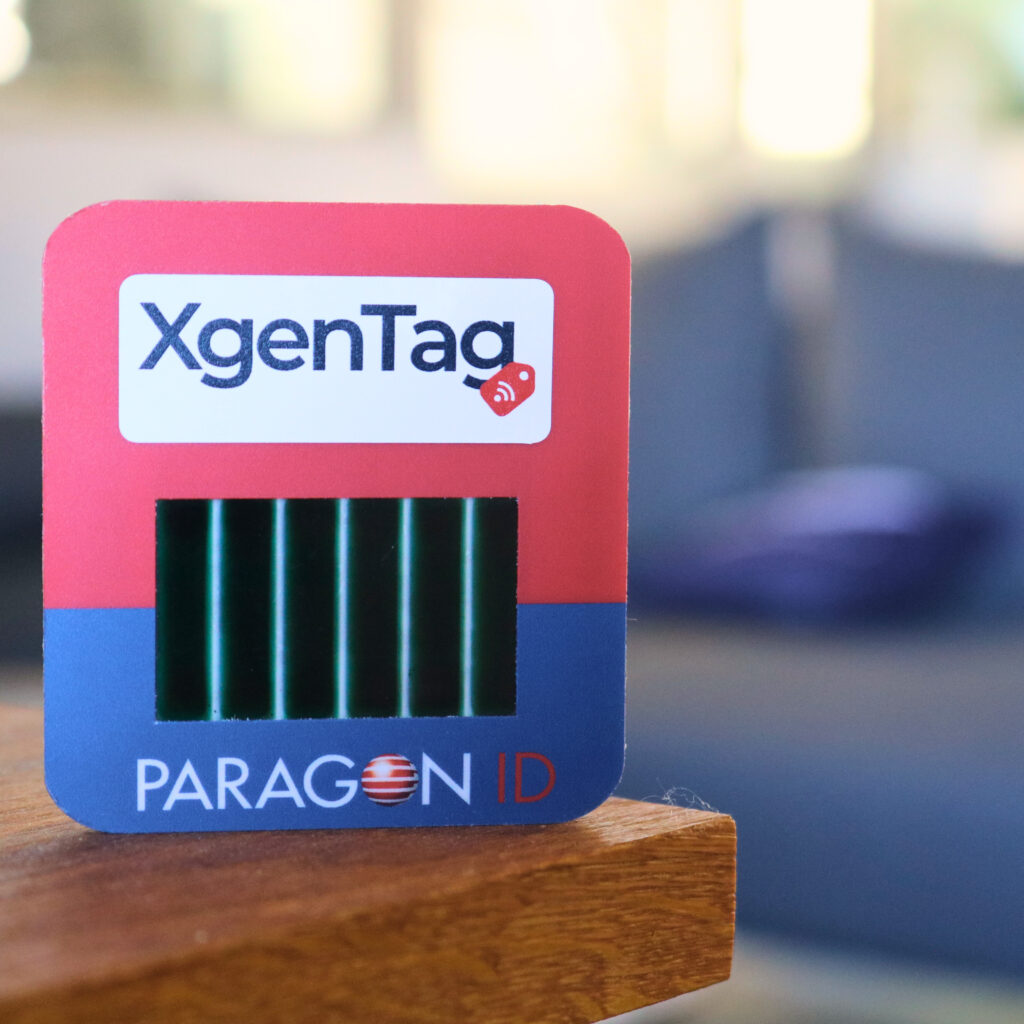
Dracula Technologies’ Organic Photovoltaic Cells capture light energy from the environment, from as little as 5 lux (dim warehouse conditions), to power the BLE chip inside each tag.
This allows XgenTag-L to operate autonomously across a wide range of environments, transmitting data every second in bright conditions, and ensuring reliable tracking without ever needing recharging or battery replacement.
Because the data can be read using any smartphone or BLE-compatible device, customers can deploy the tags easily within existing systems, without heavy infrastructure investments.
XgenTag-L provides the flexibility and performance needed across multiple use cases:
- Continuous inventory tracking
- Exposed or multi-site supply chains
- Smart retail and warehouse environments
- Asset search and retrieval
- Industrial and logistics flow optimization
The collaboration between Paragon ID and Dracula Technologies demonstrates how light energy harvesting can unlock the next generation of smart, autonomous tracking, combining sustainability, scalability, and real-time visibility in a single, battery-free solution.
V. Conclusion
The rules of supply chains have changed. Customers expect real-time, context-rich visibility at scale. Traditional systems, passive tags or battery-powered sensors, cannot deliver.
Dracula Technologies’ Organic PV modules remove the last structural barrier: the battery. By enabling autonomous, maintenance-free smart labels, we shift asset tracking from fragmented snapshots to continuous, context-aware intelligence, with no operational overhead and no environmental trade-offs.
Solutions like the Truvami® Smart Label or Paragon ID’s XgenTag-L, prove that this model is not a distant vision, but an industrial reality. Battery-free tracking is scalable across millions of assets and perfectly aligned with circular supply chains and regulatory requirements.
For logistics providers, manufacturers, and retailers, the message is clear:
- Boost efficiency with uninterrupted, real-time visibility across the supply chain.
- Stay ahead of regulation with compliant, sustainable materials.
- Win customer trust by guaranteeing transparency and quality at every step.
The opportunity is here: those who adopt OPV-powered smart tracking today will set the new benchmark for tomorrow’s supply chains.
Those who wait risk being left behind.